
Measurement of potassium in soil
In laboratories, potassium in soil is extracted with 1M ammonium acetate and analyzed with Atomic Absorption (AA) or Inductivity Coupled Plasma-Optical Emission Spectrometry (ICP-OES). LAQUAtwin potassium ion meter showed values higher than those of ICP-OES. However, with 0.01M ammonium acetate extraction, good correlation (r=0.981, r2=0.962) was obtained between ICP-OES and LAQUAtwin potassium ion meter.



Introduction
Typically, Atomic Absorption (AA) or Inductivity Coupled Plasma-Optical Emission Spectrometry (ICP-OES) is used to measure potassium ion, by first extracting the potassium ion from sample soils by 1 mol/L ammonium acetate (CH3COONH4). These are the methods performed in laboratories.
A simpler method for a rapid measurement of potassium ion in soil uses the LAQUAtwin potassium ion meter B-731. The extraction method is the same as the lab method. The following procedure explains how you can measure K+ with good correlation to analytical lab tests.
Method
- Put 1g each of air-dried soils (four samples) in 100mL glass beakers, two beakers per soil sample.
- Prepare two kinds of extraction per soil sample, one by adding 20 ml of 1mol/L CH3COONH4 to one beaker, and 20ml of 0.01mol/L CH3COONH4 to another beaker.
- Shake the beakers around 1 hour to extract K+ from the soil using a bench top shaker.
- Calibrate LAQUAtwin B-731 with 150mg/L and 2000mg/L K+ standard solutions included in the product.
- Measure potassium ion concentration of the filtrated solution with calibrated B-731 and with ICP-OES (e.g. HORIBA Jobin Yvon. Model ULTIMA2).
- Perform this measurement with 4 different samples.
Results and Benefits
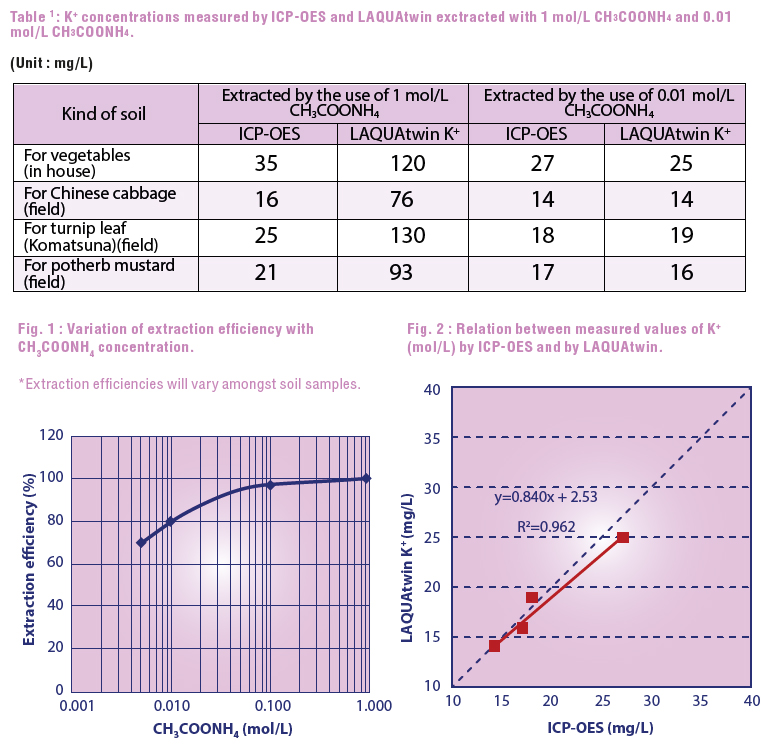
The Laqua Twin B-731 allows for a simple on site determination of potassium which provides accuracy close to laboratory techniques. 1Table 1 shows the results from ICP-OES and LAQUAtwin K+ extracted with 1 mol/L and 0.01 mol/L CH3COONH4.
1Internal study by HORIBA labs, 2013
Based on table 1, higher value against ICP-OES is detected by LAQUAtwin K+ with 1 mol/L CH3COONH4 extraction, due to strong interference by NH+ of CH3COONH4. However, with 0.01 mol/L CH3COONH4 extraction, although the extraction efficiency is reduced by approximately 80%* (Figure 1), very good correlation (R=0.981, R2=0.962) is obtained between ICP-OES and LAQUAtwin (Figure 2).
Figure 1 shows the potassium extraction efficiency measured with ICP-OES. Setting 1 mol/L CH3COONH4 extraction as 100%, efficiency trend is plotted depending on different CH3COONH4 concentration.
Figure 2 shows the correlation between ICP-OES and LAQUAtwin K+ measurements with 0.01 mol/L CH3COONH4 extraction.
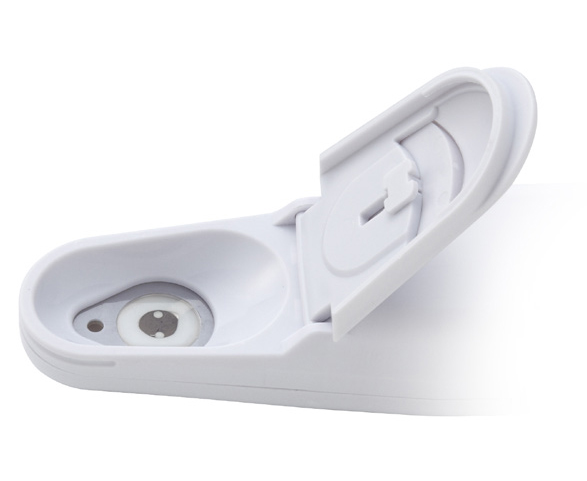
LAQUAtwin: the only meters with flat sensor technology.
HORIBA’s highly-sensitive, flat sensor technology opens up new possibilities for sampling and sample types. Only a small amount of sample is required, so you can easily sample in situ without the need for beakers or other labware. Sensors are easily replaced as required.
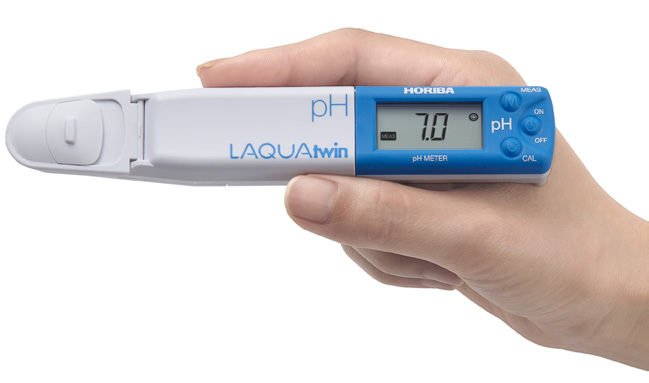
Calibrate and measure at the touch of a button — the smiley face will tell you when the result can be read.
LAQUAtwin is fully waterproof and dustproof.
The meter and sensor are fully waterproof* and dustproof, so you can take it anywhere.
* IP67 rated. Will withstand immersion for 30 minutes at 1 m. Not suitable for underwater use.
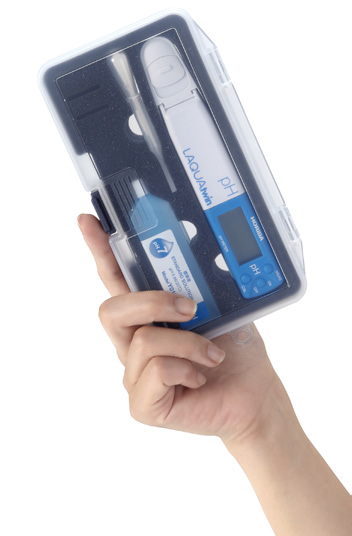
Carry case comes as standard for handy portability.
The compact carry case contains everything you need for your measurements, including the standard solution and sampling sheets.
Matching products

Precise Potassium Ion Measurement on the Go – Mobile, Reliable, and Easy Precise potassium ion measurement with 2-point calibration and integrated temperature display The Horiba K-11 Potassium Pocket Tester was designed to determine potassium in a wide variety of samples with high precision. Thanks to the ion-selective electrode and the digital LCD screen with backlight, the tester is perfect for mobile water quality and environmental analyses. The minimal sample volume of only 0.3 ml (0.05 ml with sampling sheet) ensures reliable results even with small sample sizes. With its 2-point calibration and automatic standard recognition, the device can be flexibly adapted to different measurement conditions. The IP67 rating for dust and water protection, along with a long battery life of up to approximately 400 hours, makes the tester highly reliable for mobile use. Technical Features for Reproducible Potassium Measurements The potassium tester covers a wide measurement range from 4 to 9,900 ppm (mg/L) and additionally displays temperatures up to 50 °C with a resolution of 0.1 °C. The integrated temperature compensation ensures stable results even under changing environmental conditions. Automatic standard recognition, adjustable calibration values, and multiplication compensation guarantee high reproducibility across different sample types. This makes the K-11 suitable for both routine and demanding analytical tasks. Why Potassium Measurement Is Important – Ideal with the Horiba K-11 Hand Tester Potassium is an essential parameter in water, environmental, agricultural, and food analysis. In water bodies, potassium content affects water quality, in soils it is a key nutrient for healthy plant growth, and in food it plays an important role for nutrition and labeling requirements. A mobile potassium hand tester enables rapid on-site analysis without time-consuming laboratory testing. Changes can be detected immediately, and decisions can be made right away. The Horiba K-11 combines this flexibility with high measurement accuracy and ease of use – ideal for fieldwork, routine checks, and scientific studies. Where Can It Be Used? Environmental Monitoring: The K-11 is a fast and precise measurement tool for environmental technicians and scientists monitoring potassium concentrations in water bodies to ensure water quality and identify contamination sources. Agriculture: The K-11 allows farmers and agronomists to measure potassium in soil. This is crucial for fertilizer application and improving plant growth. Easy evaluation of soil extracts enables precise nutrient requirement determination. Food Industry: The tester is used by quality assurance personnel to check potassium content in beverages and food. These measurements are important for product development, health assessments, and compliance with nutritional labeling requirements. Teaching, Research, and Development: By deepening the understanding of potassium’s role in biological and chemical processes, the K-11 serves researchers and educators as a useful tool for experimental studies and educational purposes. Frequently asked questions How long is the warranty period for HORIBA pocket testers? The warranty period is two years from delivery for commercial customers. How many measurements can be taken before the sensor needs to be replaced? This varies depending on the application, use and storage of the Horiba tester. As a rule, the sensor should be replaced after one year. How long is the warranty period for replacement sensors for pocket testers? The warranty period is 12 months after delivery for commercial customers. How do you clean the pocket tester? The pocket tester can be rinsed under water. We recommend cleaning with DI water (deionised). Tissue paper is recommended for drying after cleaning. How can the pocket tester be reset to factory settings? (e.g. in the event of an incorrect measurement result) This information can be found in the operating instructions. These can be found in the download area of the shop and on the product. Is calibration necessary before each measurement? Basically, yes. Further information can be found in the operating instructions.
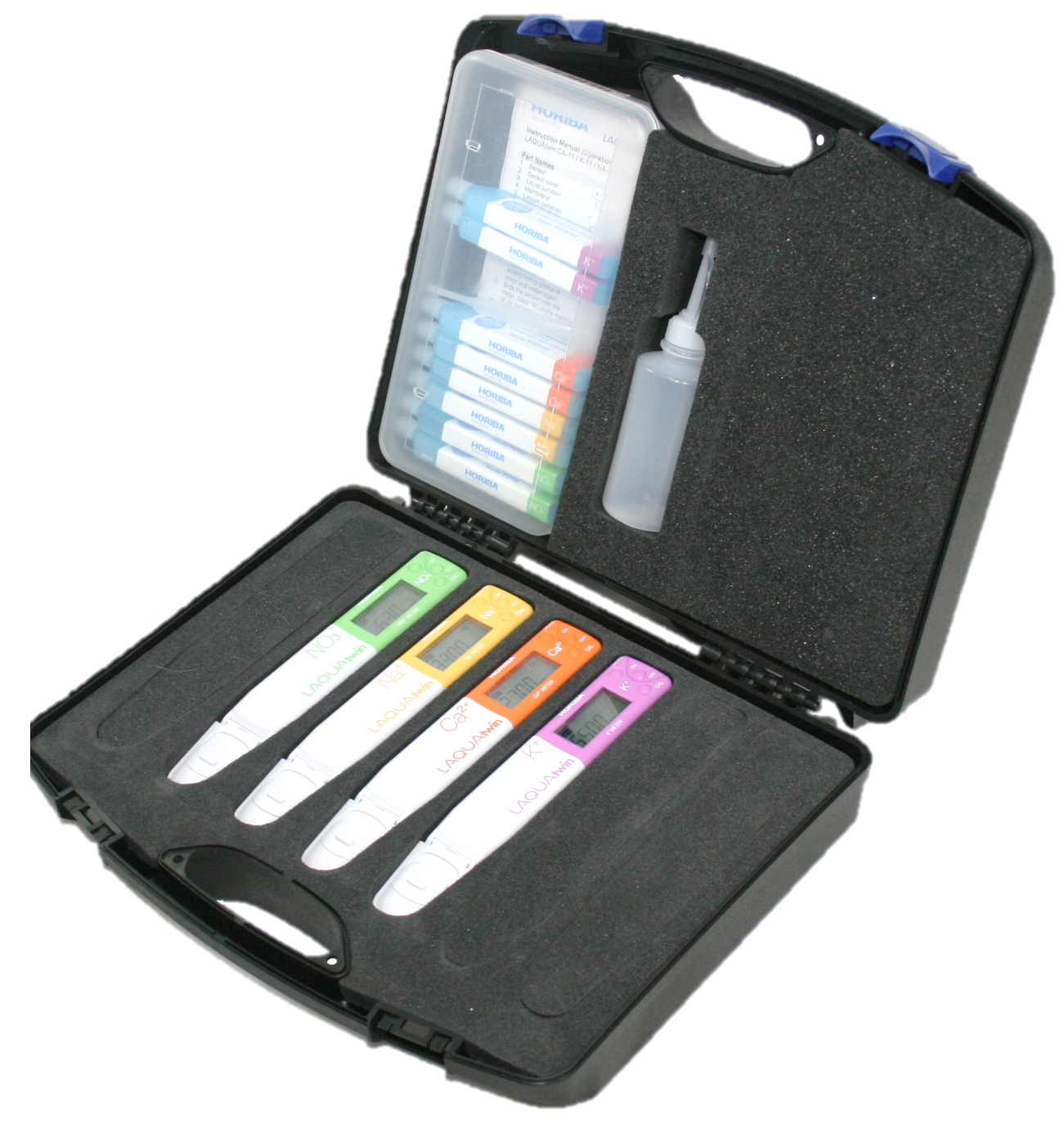
Mobile Analysis Laboratory for Ion Measurements – Versatile Use Compact kit for simultaneous determination of multiple water and environmental parameters The Horiba 4M LAQUAtwin Kit is a mobile laboratory that allows you to determine important ion parameters directly on-site. The case contains pocket testers for measuring sodium, potassium, nitrate, and calcium, as well as for temperature measurement. Each device uses ion-selective electrodes for targeted analysis of small samples and provides fast, reliable results. In addition to the four measurement devices, the kit includes calibration solutions and a wash/spray bottle for sensor cleaning. The sensors can be stored dry without special storage solutions. Compact Multi-Parameter Kit for Flexible On-Site Analyses The set is designed for measurement tasks where multiple ions need to be detected simultaneously, for example when monitoring drinking and process water, performing environmental checks of water bodies, conducting aquaculture analyses, or agricultural research. Thanks to the case, all essential testers including accessories are always on hand and ready for immediate use. The measurement results are available in a short time and are reliable and reproducible – ideal for routine and control measurements in the field. All components are neatly arranged in the case and ready for use at any time. An additional advantage is that the sensors can be stored dry without special storage solutions. Due to its compact design, the kit is particularly suitable for mobile applications where multiple ion parameters need to be determined quickly one after the other or in parallel. Why Multi-Parameter Ion Measurements Are Useful – and a Mobile Kit Is Ideal In many applications, not just a single measurement is important, but the interaction of multiple ion parameters. Sodium, potassium, nitrate, and calcium together influence water quality, biological processes, plant growth, and technical operations. Single measurements in a laboratory are often time-consuming and inflexible. A mobile analysis kit allows simultaneous detection of multiple parameters directly on-site. This allows relationships to be recognized more quickly, decisions to be made more reliably, and measurement campaigns to be carried out more efficiently. The Horiba 4M LAQUAtwin Kit combines these advantages in a compact, user-friendly system. Frequently asked questions How long is the warranty period for HORIBA pocket testers? The warranty period is two years from delivery for commercial customers. How many measurements can be taken before the sensor needs to be replaced? This varies depending on the application, use and storage of the Horiba tester. As a rule, the sensor should be replaced after one year. How long is the warranty period for replacement sensors for pocket testers? The warranty period is 12 months after delivery for commercial customers. How do you clean the pocket tester? The pocket tester can be rinsed under water. We recommend cleaning with DI water (deionised). Tissue paper is recommended for drying after cleaning. How can the pocket tester be reset to factory settings? (e.g. in the event of an incorrect measurement result) This information can be found in the operating instructions. These can be found in the download area of the shop and on the product. Is calibration necessary before each measurement? Basically, yes. Further information can be found in the operating instructions.