
Measuring nitrate levels in well water for livestock farming: Why it is essential
Reliably monitoring water quality and protecting animal Health
Clean water forms the basis of any successful livestock farming operation. Farms that source their drinking water from deep wells, in particular, should monitor water quality regularly, as elevated nitrate levels in groundwater are not uncommon and can significantly impair the health of farm animals.
Whether it’s a dairy farm, pig rearing, poultry farming or a horse farm – animals consume large quantities of water every day. The quality of this water affects not only the health and performance of the animals, but also the profitability of an agricultural business.
Regular monitoring of nitrate levels is becoming increasingly important, particularly when using deep wells and on-farm water sources. Agricultural inputs, natural soil conditions or regional groundwater pollution can lead to rising nitrate concentrations in well water. Without regular self-monitoring, elevated levels often go unnoticed for a long time.
This article explains where nitrate in well water comes from, what risks it poses to animals, and how water quality can be monitored easily and reliably on site.
With modern on-site analysers from HORIBA, nitrate concentrations can be determined quickly and accurately without the need for time-consuming laboratory analyses. This enables farmers to take early action and monitor water quality on an ongoing basis.
Why water quality is crucial
Water is just as important for farm animals as feed. Cows, pigs, poultry and horses consume large quantities of it every day – but the water they drink from their troughs not only provides essential minerals, but may also introduce undesirable substances into their systems. Nitrate is one of the parameters that is often underestimated in practice, even though it can have a direct impact on the animals’ performance, fertility and general vitality.
High-quality water supports:
- Feed intake
- Digestion
- Metabolism
- Milk yield
- Weight gain
- Fertility
- Overall animal welfare
Well water is generally regarded as a high-quality source of water. Nevertheless, groundwater is subject to natural fluctuations and regional contamination. Nitrate, in particular, is one of the most important parameters in water monitoring.
Reliable water quality is therefore not just a "nice-to-have", but a key component of animal health, operational safety and, ultimately, the profitability of a farm.
Regular water analyses provide peace of mind and help to identify changes at an early stage. Knowing the nitrate levels in your drinking water allows you to take timely action, rather than waiting until visible health problems arise in the animals.
Where does nitrate in well water come from?
Nitrate is a naturally occurring nitrogen compound found in groundwater in varying concentrations.
Plants require nitrate as an essential nutrient. However, problems arise when, over a prolonged period, more nitrogen is introduced into the soil than plants can absorb.
Typical causes of elevated nitrate levels include:
-
Agricultural fertilisation
Inorganic and organic fertilisers, as well as slurry, contain nitrogen compounds that are converted into nitrate in the soil. If more nitrogen is applied than the plants can absorb, the excess seeps into deeper soil layers with percolating water and eventually enters the groundwater. -
Geological and site-specific factors
Soil composition, the distance to the water table and the permeability of the subsoil influence how quickly and in what concentration nitrate enters a well. Shallow or unprotected wells are particularly vulnerable in this regard. -
Livestock farming itself
Manure from livestock farming – for example, if farmyard manure is stored improperly near a well – can also contribute to locally elevated nitrate levels. Farms with their own water supply therefore have a direct influence on the quality of their own drinking water. -
Natural fluctuations
The season, rainfall or water levels can influence nitrate concentrations.
Deep wells in particular are often regarded as especially safe. Nevertheless, numerous monitoring programmes show that even deeper aquifers can exhibit regionally elevated nitrate levels.
What effects does nitrate have on animals?
The health consequences of elevated nitrate levels vary significantly depending on the animal species, as the digestive system and metabolism play an important role.
Ruminants (cattle, sheep and goats)
In ruminants, nitrate is converted by microorganisms in the rumen into nitrite – a compound that is significantly more toxic than nitrate itself. Nitrite can convert haemoglobin into methaemoglobin, thereby disrupting oxygen transport in the blood. Possible consequences include shortness of breath, reduced performance, fertility problems and, in cases of very high exposure, acute symptoms of poisoning.
Pigs and poultry (monogastric animals)
In monogastric animals, the conversion of nitrate to nitrite is slower. Nevertheless, chronically elevated levels can impair feed intake, growth and general vitality. Young animals and pregnant or laying animals are particularly sensitive.
Horses
In horses, prolonged nitrate contamination of drinking water can also lead to non-specific symptoms such as reduced willingness to perform or digestive problems. As horses are sensitive to changes in water quality, regular monitoring is particularly important in this case.
Overall, the following applies: the higher the nitrate levels and the longer the exposure, the greater the risk of adverse health effects – regardless of the animal species.
Nitrate in Research and Veterinary Medicine
The links between nitrate levels in drinking water and animal health have long been the subject of research in veterinary medicine and agricultural science.
Studies focus, amongst other things, on:
- The effect of nitrate doses on fertility and metabolism
- Interactions between nitrate levels in water and in feed
- The development of practical limit values for different animal species and life stages
For vets, veterinary faculties and research institutions, reliable and reproducible nitrate measurement is therefore not only a monitoring tool but also an important data source for scientific research and for advising agricultural businesses. Portable measuring devices are of particular interest for scientific work, as samples can be analysed immediately at the point of collection.
Legal requirements and recommendations
In Germany and the EU, there are clear legal limits for nitrate in drinking water. In the European Union, the limit for nitrate in drinking water is 50 mg/L. This limit is intended to protect human health and is often used as a guideline for assessing well water.
Although there are no statutory requirements for livestock drinking water that are as strict as those for drinking water intended for human consumption, many technical recommendations are based on comparable guidelines in order to ensure animal health and food safety.
Farms with their own water supply from deep wells bear a particular responsibility in this regard: they are responsible for monitoring water quality themselves and should not rely solely on one-off or infrequent laboratory analyses. Precisely because nitrate levels in groundwater can vary seasonally and depending on location – for example, following periods of fertilisation or heavy rainfall – continuous, frequent monitoring is recommended.
Why regular on-site measurements are useful
Whilst traditional laboratory analyses provide precise results, they involve waiting times, the hassle of posting samples and additional costs. In practical farming terms, this means that by the time the results are available, the animals may already have been drinking contaminated water for days or weeks.
Mobile nitrate analysers bridge this gap. They enable water samples to be analysed directly at the well or in the drinking trough—without the need for a laboratory and without long waiting times.
This offers several advantages for farms, vets and consultants:
- Rapid response: Elevated levels are detected immediately, allowing countermeasures to be taken promptly.
- Regular self-monitoring: Instead of one-off spot checks, water quality can be continuously monitored as part of day-to-day farm operations.
- Cost-effectiveness: On-site measurements reduce the need for costly external laboratory analyses for routine monitoring.
- Documentation and advice: Regularly recorded measurement data help vets and agricultural advisers provide well-founded recommendations.
The HORIBA nitrate range for rapid on-site analysis
To facilitate the practical implementation of regular nitrate monitoring, HORIBA offers the LAQUAtwin series: compact, ion-selective handheld analysers specifically designed for different sample types. All instruments impress with their ease of use, low sample requirements and reliable, temperature-compensated measurement results – ideal for use directly at the well, in the barn or in the field.
HORIBA LAQUAtwin NO3-11 – Nitrate tester for water samples
Item number: 895659
The LAQUAtwin NO3-11 is the entry-level tester for the direct determination of nitrate ions and temperature in water and environmental samples. With 2-point calibration, automatic standard recognition and a digital LCD display, it delivers precise results with minimal sample consumption – making it ideal for the regular monitoring of drinking and well water in livestock farming.
Typical applications: Monitoring of drinking and irrigation water, water quality management, environmental monitoring, research into the nitrogen cycle.
HORIBA LAQUAtwin NO3-11C – Nitrate analysis kit for plant samples
Item number: 895688
The NO3-11C is supplied in a handy case, complete with pipettes, measuring cups and a plant sample press. With a measurement range of 6 to 9,900 ppm NO₃⁻, it is particularly suitable for analysing plant sap – relevant for businesses that wish to monitor not only irrigation water but also the nutrient supply to their forage crops.
Typical areas of application: aquaculture, horticulture, forage crop production, environmental monitoring, laboratory and training use, water treatment and conditioning.
HORIBA LAQUAtwin NO3-11S – Nitrate tester for soil analysis
Item number: 895689
The NO3-11S is specifically designed for determining the nitrate content in soil and is also supplied as a complete set with pipettes, sample bottles, spoons and accessories. It complements water analysis by adding a soil perspective and helps to manage fertilisation measures in a targeted manner – an important factor in reducing nitrate pollution in groundwater in the long term.
Typical areas of application: soil analysis in agriculture, optimisation of fertilisation, ecological studies on the environmental impact of agriculture.
Advantages of HORIBA nitrate analysers at a glance
- Precise ion-selective measurement technology
- Fast results directly on site
- No need for time-consuming laboratory analyses
- Small sample volumes
- Easy to use
- Compact design
- Temperature compensation
- Ideal for routine monitoring
- Available for water, plant and soil analysis
Why HEYL Neomeris?
As a specialist in water analysis, HEYL Neomeris offers high-quality measurement solutions for agriculture, environmental technology, research and veterinary medicine. With the HORIBA LAQUAtwin instruments, users benefit from reliable measurement technology for mobile use – ideal for regular self-monitoring and a well-founded assessment of water quality.
Our range of services at a glance:
- Personalised and expert advice
- Tailored support in selecting the right measuring instrument
- Comprehensive service
- Maintenance and spare parts supply
- Long-term support and personalised assistance
With us, you not only receive a high-quality measuring instrument, but also a tailor-made, comprehensive solution for professional and reliable water monitoring.
Conclusion: Monitor nitrate levels regularly and safeguard animal health in the long term
Monitoring provides peace of mind
A reliable water supply forms the basis for healthy animals and economically successful farms. Particularly when using private deep wells, nitrate levels should be checked regularly in order to detect changes at an early stage and make informed decisions.
The portable HORIBA LAQUAtwin nitrate testers provide farmers, vets, water consultants and research institutions with a fast, precise and practical solution for on-site analysis. Whether it’s well water, plant sap or soil – HORIBA’s handheld analysers enable flexible monitoring of key nitrate parameters and support sustainable agriculture as well as a safe water supply in livestock farming. They allow water quality to be checked quickly, easily and without laboratory waiting times, directly on site – ensuring greater safety in dairy cattle, pig, poultry and horse farming, as well as in veterinary consultancy and research.

Horiba LAQUAtwin Nitrate Ion Tester NO3-11 for Precise On-Site Measurements Handheld tester with 2-point calibration, ideal for water and environmental measurements The Horiba LAQUAtwin Nitrate Ion Tester (NO3-11) is a portable device for direct determination of nitrate ions (NO3) and temperature in liquids and samples. Thanks to the ion-selective electrode and compact design, the tester delivers fast and reliable results. The integrated temperature unit enables temperature-compensated analysis and clearly displays both nitrate and temperature values on the digital LCD display. Mobile Nitrate Ion Tester for Precise On-Site Analyses The integrated temperature measurement enables temperature-compensated analysis and shows both nitrate and temperature values. Only very small sample volumes are required, minimizing sample consumption and increasing efficiency in daily use. The tester can be set up with up to two calibration points, with features such as automatic standard recognition, adjustable calibration values, and multiplication compensation for flexibility. Only minimal sample volumes are needed for each analysis, reducing sample usage and improving efficiency. Why Nitrate Measurement Is Crucial – and a Pocket Tester from Horiba Is Ideal Nitrate measurement plays a central role in agriculture, water management, and environmental monitoring. Elevated nitrate concentrations can affect drinking water quality, stress ecosystems, and contribute to over-fertilization. At the same time, nitrate is an essential nutrient for plants, and targeted control is vital for sustainable agriculture. A mobile nitrate pocket tester enables rapid on-site analysis without time-consuming laboratory tests. This allows early detection of contamination, immediate action, and reliable monitoring of legal limits. The Horiba LAQUAtwin NO3-11 combines this flexibility with high measurement accuracy and easy operation – ideal for routine checks and scientific applications. The tester can be configured with up to two calibration points. Features like automatic standard recognition, adjustable calibration values, and multiplication compensation provide high adaptability to different sample types and measurement conditions. Typical Applications of the Horiba LAQUAtwin Nitrate Ion Tester (NO3-11) Agriculture: To optimize fertilizer use, promote plant growth, and minimize environmental impact, farmers and agronomists use the tester to monitor nitrate levels in soils and irrigation water. Water Quality Management: To maintain nitrate concentrations within safe limits, the NO3-11 is used in water management to check drinking and wastewater quality. Environmental Monitoring: The NO3-11 allows environmental technicians and scientists to quickly analyze nitrate contamination in rivers, lakes, and groundwater, ensuring compliance with environmental standards and identifying pollution sources. Research and Development: The tester is used by scientists in environmental science, hydrology, and soil science to conduct detailed studies of the nitrogen cycle and the effects of nitrates on ecosystems. Additional information We would like to inform you of an upcoming product update for the LAQUAtwin handheld analysers. To enhance product safety and prevent infants and young children from accidentally swallowing the batteries, HORIBA will be introducing a new battery cover on all LAQUAtwin pocket-sized analysers. Overview of the product change Change: Battery cover for enhanced safety. Reason: To prevent accidental swallowing of batteries. Production date: From January 2026 in Japan Deliveries to EMEA distribution partners: From March 2026 As this change is currently being rolled out, mixed deliveries of the current and updated versions may occur during the transition period. Frequently asked questions How long is the warranty period for HORIBA pocket testers? The warranty period is two years from delivery for commercial customers. How many measurements can be taken before the sensor needs to be replaced? This varies depending on the application, use and storage of the Horiba tester. As a rule, the sensor should be replaced after one year. How long is the warranty period for replacement sensors for pocket testers? The warranty period is 12 months after delivery for commercial customers. How do you clean the pocket tester? The pocket tester can be rinsed under water. We recommend cleaning with DI water (deionised). Tissue paper is recommended for drying after cleaning. How can the pocket tester be reset to factory settings? (e.g. in the event of an incorrect measurement result) This information can be found in the operating instructions. These can be found in the download area of the shop and on the product. Is calibration necessary before each measurement? Basically, yes. Further information can be found in the operating instructions.

Precise Nitrate Tester for Plants – Mobile NO₃⁻ Analysis On-Site Horiba Nitrate Ion Pocket Tester Kit for fast and accurate on-site results The Horiba LAQUAtwin Nitrate Ion Hand Tester (NO3-11C) in its practical analysis kit is your mobile laboratory for reliable determination of nitrate ions and temperature in plant sap samples. With a wide measurement range of 6 to 9900 ppm NO₃⁻ and automatic temperature compensation, the device provides fast and accurate results. The ion-selective electrode ensures precise NO₃⁻ measurements, while the digital backlit display allows quick and easy reading of values. Mobile nitrate analysis kit for plants, water, and environmental monitoring The kit contains the handheld tester, five pipettes, three measuring cups, a plant sample press, standard solutions, and sampling sheets. This setup allows for rapid and reproducible analysis of plant sap without the need for additional laboratory equipment. The device is dust- and waterproof, features automatic standard recognition, Auto-Stabil and Auto-Hold functions, and has a long battery life, making it ideal for mobile use in the field, greenhouse, or laboratory. Why nitrate measurement in plants is important – and why a mobile kit is ideal Nitrate content in plants is a key indicator of nutrient supply, plant growth, and agricultural product quality. Excessively high or low nitrate levels can negatively impact yield, plant quality, and environmental compatibility. A mobile nitrate hand tester allows direct analysis of plant sap on-site, without time-consuming laboratory procedures. Fertilization and irrigation measures can be precisely adjusted, and over- or under-supply can be detected early. The Horiba LAQUAtwin NO3-11C provides a precise, fast, and practical solution for this purpose. Typical applications for the Horiba Nitrate Analysis Kit Aquaculture and coral monitoring Aquaristics Horticulture Beverage and food production Laboratories and schools Environmental monitoring Water treatment Water conditioning Additional information We would like to inform you of an upcoming product update for the LAQUAtwin handheld analysers. To enhance product safety and prevent infants and young children from accidentally swallowing the batteries, HORIBA will be introducing a new battery cover on all LAQUAtwin pocket-sized analysers. Overview of the product change Change: Battery cover for enhanced safety. Reason: To prevent accidental swallowing of batteries. Production date: From January 2026 in Japan Deliveries to EMEA distribution partners: From March 2026 As this change is currently being rolled out, mixed deliveries of the current and updated versions may occur during the transition period. Frequently asked questions How long is the warranty period for HORIBA pocket testers? The warranty period is two years from delivery for commercial customers. How many measurements can be taken before the sensor needs to be replaced? This varies depending on the application, use and storage of the Horiba tester. As a rule, the sensor should be replaced after one year. How long is the warranty period for replacement sensors for pocket testers? The warranty period is 12 months after delivery for commercial customers. How do you clean the pocket tester? The pocket tester can be rinsed under water. We recommend cleaning with DI water (deionised). Tissue paper is recommended for drying after cleaning. How can the pocket tester be reset to factory settings? (e.g. in the event of an incorrect measurement result) This information can be found in the operating instructions. These can be found in the download area of the shop and on the product. Is calibration necessary before each measurement? Basically, yes. Further information can be found in the operating instructions.
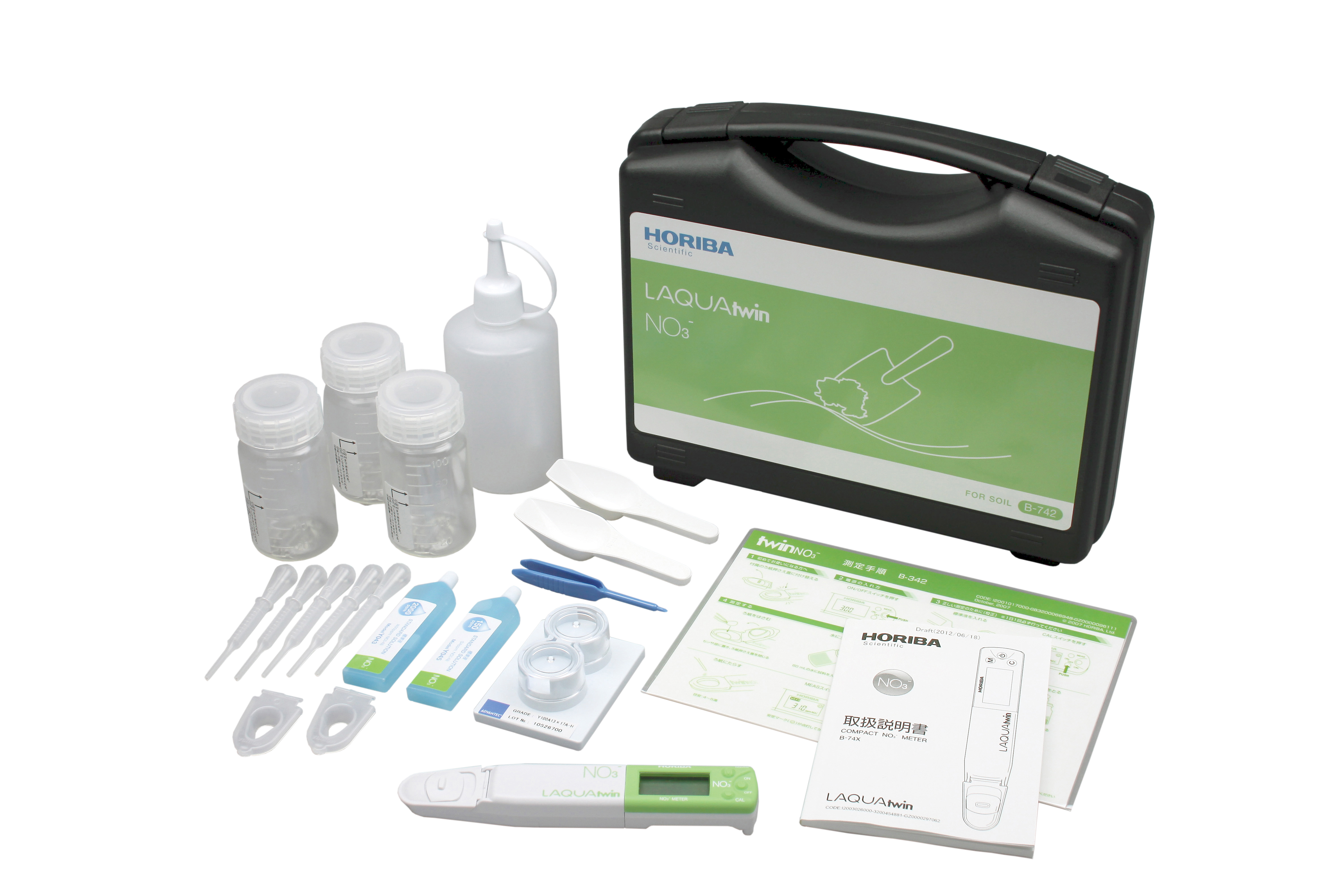
The LAQUAtwin Nitrate Ion Handheld Tester (NO3-11C) included in the analysis kit is pre-set by the factory to the relevant calibration points 30PPM and 300PPM for soil analysis. Manufacturer Part No. 3200689164 | B-742 Additional information We would like to inform you of an upcoming product update for the LAQUAtwin handheld analysers. To enhance product safety and prevent infants and young children from accidentally swallowing the batteries, HORIBA will be introducing a new battery cover on all LAQUAtwin pocket-sized analysers. Overview of the product change Change: Battery cover for enhanced safety. Reason: To prevent accidental swallowing of batteries. Production date: From January 2026 in Japan Deliveries to EMEA distribution partners: From March 2026 As this change is currently being rolled out, mixed deliveries of the current and updated versions may occur during the transition period.
Would you like to find out more about the right nitrate measurement solution for your farm?
Our team will be happy to advise you on the selection, application and handling of the HORIBA LAQUAtwin series.
Service hotline:
+49 (0)5121 7609-99
Email:
vertrieb@heylneomeris.de