
1. Sampling
- In the morning between 8–11 a.m.
- 20–30 fully developed leaves from the middle shoot position
- Use petioles only
Technical information on the measurement of nutrients in apple petiole sap and fruit juice. The analysis of potassium (K⁺), calcium (Ca²⁺), nitrate (NO₃⁻), sodium (Na⁺), pH, and EC enables a precise assessment of the current nutrient status in fruit cultivation.
The measurement of leaf and fruit sap ions using devices such as the LAQUAtwin is of great importance in apple cultivation. Sap measurements provide a snapshot of the nutrients actually being transported within the plant – not just the elements present in the soil.
Soil analyses alone are insufficient, as nutrient availability can change daily depending on water uptake, growth stage, and environmental stress.
Measurable parameters include K⁺, NO₃⁻, Ca²⁺, Na⁺, pH, and EC in fruits, leaves, soil, and water.

Modern apple production is no longer limited by the availability of fertilizers, but by nutrient balance, timing of fertilization, and the efficiency of nutrient uptake by plants. Disorders such as bitter pit, cork spot, poor storability, excessive vegetative growth, and inconsistent fruit quality are almost always the result of nutrient imbalances that occur during the growing season rather than at harvest. For this reason, real-time measurement devices – ion, pH, and EC meters – have become indispensable tools for professional apple orchards.
Ion-specific measurements (K⁺, Ca²⁺, NO₃⁻, Na⁺) provide direct insight into what the tree is actually absorbing and transporting at that moment. Unlike soil tests or traditional leaf tissue analyses, sap ion measurements reflect current physiological conditions and allow growers to detect problems early – often weeks before visual symptoms or irreversible fruit damage appear.
Key benefits include:
• Early detection of K–Ca imbalance, the primary cause of bitter pit and storage disorders.
• Improved control of nitrogen-driven vigor, fruit size, and ripening timing.
• The ability to adjust fertigation and foliar feeding programs proactively rather than reactively.
• Reduction of waste through unnecessary fertilizer applications.
In high-value varieties such as Golden Delicious, these measurements can make the difference between marketable fruit and significant storage losses.
While ion meters indicate which nutrients are present, pH and EC explain why uptake succeeds or fails.
• pH determines nutrient availability and ion competition at both root and leaf level. Even optimal Ca or K values are ineffective if pH conditions restrict uptake.
• Electrical conductivity (EC) provides a rapid indicator of total salt concentration and osmotic stress. Elevated EC reduces water uptake, limits calcium movement, and often precedes sodium or chloride toxicity.
Together, pH and EC measurements enable growers to:
• Detect salt stress at an early stage
• Diagnose irrigation and fertigation problems
• Correctly interpret ion measurement values and avoid misjudgments – without the context of pH and conductivity, ion data alone can be misleading.
• For leaves: Select healthy, fully expanded leaves from similar positions.
• For fruits: Typically, fruit juice is sampled rather than sap from leaf veins; this is particularly suitable for nitrate, potassium, sodium, and calcium, as the meters are compatible with juice measurements.
• Leaves: Use a petiole sap press (similar to a garlic press) or a small hand press to squeeze out the sap.
• Apples: Crush or cut the apple and collect the juice; filter out solids so that the meter only comes into contact with clear liquid.
• Dilute the samples if necessary with deionized or distilled water so that the ion concentration falls within the calibrated measurement range of the meter.
Standardized protocol for extracting and preparing petiole sap for ion measurement (NO₃⁻, K⁺, Ca²⁺, Na⁺) in apple production.
Apple sap is generally too concentrated for Ca and K meters. Standard dilution:
| Parameter | Recommended Dilution |
|---|---|
| NO₃⁻ | 1:5 |
| K⁺ | 1:10 |
| Ca²⁺ | 1:10 |
| Na⁺ | 1:5 |
Dilution (example 1:10): Take 0.10 ml of sap and add 0.90 ml of distilled or deionized water. Mix gently. Use disposable pipettes or syringes to ensure accuracy.

The device must be calibrated before measurement.
1. Turn on the meter.
2. Rinse the sensor with demineralized or regular tap water and carefully dry it with a paper towel.
3. Place some of the 150 ppm solution onto the sensor and press the CAL button.
4. Rinse the sensor with demineralized or regular tap water and carefully dry it with a paper towel.
5. Place some of the 2000 ppm solution onto the sensor and press the CAL button.
6. Rinse and dry the sensor.
7. Apply the extracted juice onto the sensor.
8. Wait until the reading stabilizes (this takes a few seconds).
These are typical working ranges, not absolute sufficiency standards. Apple sap varies significantly depending on:
| Status | NO₃⁻ | K⁺ | Ca²⁺ | Na⁺ |
|---|---|---|---|---|
| Low | <400 | <1500 | <200 | - |
| Adequate | 400–800 | 1500–3000 | 200–500 | <50 |
| High | 800–1200 | 3000–5000 | 500–800 | 50–150 |
| Excessive | >1500 | >5000 | >800 | >150 |
Apples generally contain less nitrate than vegetables. High potassium levels often inhibit calcium uptake → risk of bitter pit. Apples require relatively high calcium levels, especially from mid- to late season. Sodium levels in apples should be very low.
| Parameter | Target Range |
|---|---|
| NO₃⁻ | <50 |
| K⁺ | 900–1500 |
| Ca²⁺ | 20–80 |
| Na⁺ | <20 |
Low calcium levels increase the risk of bitter pit.
Below are practical, stage-specific sap ranges for apples based on HORIBA LAQUAtwin NO₃⁻, K⁺, Ca²⁺, and Na⁺ meters, with variety adjustments where truly important (especially for bitter pit–prone cultivars).
These are practice-oriented target ranges, not textbook sufficiency standards. They are designed for orchard decision-making, not laboratory diagnostics.
STANDARD APPLES (LOW TO MODERATE BITTER PIT RISK)
Examples: Gala, Fuji, Braeburn, Elstar
| Stage | NO₃⁻ | K⁺ | Ca²⁺ | Na⁺ |
|---|---|---|---|---|
| Post-bloom (10–35 days after full bloom, DAFB) | 600–1000 | 2500–4000 | 300–600 | <50 |
| Early fruit development (35–60 DAFB) | 500–800 | 2000–3500 | 350–650 | <50 |
| Mid-season (60–90 DAFB) | 300–600 | 1800–3000 | 400–700 | <50 |
| Pre-harvest (2–4 weeks before harvest) | <300 | 1500–2500 | 450–800 | <50 |
HIGH BITTER PIT–RISK VARIETIES
Examples: Honeycrisp, Golden Delicious, Granny Smith, Jonagold
| Stage | NO₃⁻ | K⁺ | Ca²⁺ | Na⁺ |
|---|---|---|---|---|
| Post-bloom (10–35 DAFB) | 500–800 | 2000–3000 | 400–700 | <40 |
| Early fruit development (35–60 DAFB) | 400–600 | 1800–2800 | 450–750 | <40 |
| Mid-season (60–90 DAFB) | 250–500 | 1500–2500 | 500–800 | <40 |
| Pre-harvest (2–4 weeks before harvest) | <250 | 1200–2000 | 550–900 | <40 |
APPLE JUICE TARGET VALUES (AT HARVEST)
| Parameter | NO₃⁻ | K⁺ | Ca²⁺ | Na⁺ |
|---|---|---|---|---|
| Desired Range | <30 | 900–1300 | >50 | <20 |
| K:Ca Ratio | <20:1 | |||
The K : Ca ratio (potassium : calcium) in apple leaf sap is important because it strongly influences fruit quality, storability, and the risk of physiological disorders, particularly bitter pit and soft fruit.
| Stage | Target Value |
|---|---|
| Post-bloom | <8 : 1 |
| Mid-season | <6 : 1 |
| Pre-harvest | <4 : 1 |
pH and EC are also important but serve a slightly different purpose compared to ion-specific measurements such as K⁺, Ca²⁺, NO₃⁻, and Na⁺.
pH affects nutrient availability. Even if sufficient Ca or K is applied, the plant cannot efficiently absorb them if the pH is too high or too low.
Typical Ranges for Apple Sap or Irrigation Water:
Extreme pH can cause:
Key point: pH is not a nutrient ion itself, but it controls how well the plant can utilize other nutrients.
EC measures the total amount of dissolved salts in water or sap.
High EC in water or sap indicates salt stress, which can lead to:
Typical Target Ranges:
Practical Application:
| Parameter | Use | Critical For |
|---|---|---|
| K⁺, Ca²⁺, NO₃⁻, Na⁺ | Direct ion status | Nutrient balance, disorder prediction |
| pH | Nutrient availability | Ensuring applied nutrients can be absorbed |
| EC | Total salt content / salinity | Detecting stress, Na⁺ influence |
In short:
HORIBA LAQUAtwin instruments are particularly well suited for orchard use because they combine laboratory-grade ion-selective technology with true field practicality.
Key advantages include:
Importantly, LAQUAtwin meters make frequent monitoring realistic, which is essential because nutrient dynamics change rapidly post-bloom, during fruit development, and before harvest.
Apple operations that integrate ion, pH, and EC monitoring shift from calendar-based fertilization to data-driven nutrient management. This leads to:
In today’s high-cost, high-risk apple production systems, ion, pH, and EC meters are no longer optional diagnostic tools – they are essential management instruments. The LAQUAtwin platform makes this level of precision practical, affordable, and actionable for modern apple growers.

HORIBA pH Handheld Tester – Ideal for Water and Environmental Analysis Precise pH measurements on-site – compact, reliable, and easy to use The Horiba LAQUAtwin pH tester is ideal for water quality testing in rivers, drinking water, and process water. With a measurement range of 0.0 to 14.0 pH and a 2-point calibration, the tester is suitable for a wide range of pH analyses. Just a single drop of sample provides quick and reliable measurement results. The tester combines electrode, display, and sample container in a robust IP67-rated housing that is dust- and waterproof. The digital display with backlight shows both pH and mV values. Features such as automatic stability detection and Auto-Hold simplify operation. With up to 400 hours of battery life, the tester is suitable for extended measurement series. Included are calibration buffer solutions (pH 4.01 & 7.00), batteries, pipette, instruction manual, and a carrying case. Handheld pH tester for fast and precise results With its wide measurement range and 2-point calibration, the Horiba LAQUAtwin pH tester is suitable for a variety of pH analyses. Even a single drop of sample is enough to obtain fast and accurate results. Its compact design makes the mobile pH tester highly user-friendly and allows on-site measurements without complex sample preparation or laboratory infrastructure. Robust, waterproof design with comprehensive features The tester integrates the electrode, display, and sample container in a robust IP67-rated housing that is dust- and waterproof. The digital backlit display clearly shows pH and mV values. Features like automatic stability detection and Auto-Hold simplify daily use. With a battery life of up to 400 hours, the tester is suitable for long measurement series. The package includes calibration buffer solutions (pH 4.01 & 7.00), batteries, pipette, instruction manual, and a practical carrying case. Typical applications of the Horiba LAQUAtwin pH Pocket Tester Aquaculture and corals Aquariums Beer, beverages, and food Heating systems Laboratories and schools Horticulture Water treatment Frequently asked questions How long is the warranty period for HORIBA pocket testers? The warranty period is two years from delivery for commercial customers. How many measurements can be taken before the sensor needs to be replaced? This varies depending on the application, use and storage of the Horiba tester. As a rule, the sensor should be replaced after one year. How long is the warranty period for replacement sensors for pocket testers? The warranty period is 12 months after delivery for commercial customers. How do you clean the pocket tester? The pocket tester can be rinsed under water. We recommend cleaning with DI water (deionised). Tissue paper is recommended for drying after cleaning. How can the pocket tester be reset to factory settings? (e.g. in the event of an incorrect measurement result) This information can be found in the operating instructions. These can be found in the download area of the shop and on the product. Is calibration necessary before each measurement? Basically, yes. Further information can be found in the operating instructions.

Mobile pH Tester with 3-Point Calibration for On-the-Go Use Horiba LAQUAtwin pH Tester – ideal for water and environmental analysis The Horiba LAQUAtwin pH Tester pH-22 is compact, robust, and designed for mobile use. With up to three calibration points and a measurement range of 0.00 to 14.00 pH, this device delivers high precision and reliability. Direct measurement with just a single drop of sample provides fast results. Features such as automatic buffer recognition, temperature compensation, and Stabil/Hold functionality make daily operation simple and convenient. Mobile precision pH tester for reliable on-site measurements The tester combines electrode, display, and sample container in a dust- and waterproof IP67 housing, making it ideal for field and laboratory applications. The digital backlit display shows pH and mV values clearly and accurately. Automatic shut-off and battery status indicators ensure convenient operation. The package includes calibration buffer solutions (pH 4.01 and 7.00), batteries, a pipette, and a quick-start guide. Why accurate pH measurement is critical – and why a handheld tester is ideal pH is a key parameter in water, environmental, and process analysis because it significantly influences chemical reactions, biological processes, and material stability. Even small deviations can substantially impact water quality, product quality, or process safety. A mobile handheld pH tester allows fast, reliable measurements directly on site. Changes can be detected immediately, and corrective actions implemented without delay. The Horiba LAQUAtwin pH-22 combines this flexibility with high measurement precision, making it ideal for field, laboratory, and routine applications. Typical applications for the Horiba LAQUAtwin pH handheld tester Aquaculture and coral monitoring Beer, beverage, and food production Heating systems Laboratories and schools Environmental analysis Water treatment Horticulture Frequently asked questions How long is the warranty period for HORIBA pocket testers? The warranty period is two years from delivery for commercial customers. How many measurements can be taken before the sensor needs to be replaced? This varies depending on the application, use and storage of the Horiba tester. As a rule, the sensor should be replaced after one year. How long is the warranty period for replacement sensors for pocket testers? The warranty period is 12 months after delivery for commercial customers. How do you clean the pocket tester? The pocket tester can be rinsed under water. We recommend cleaning with DI water (deionised). Tissue paper is recommended for drying after cleaning. How can the pocket tester be reset to factory settings? (e.g. in the event of an incorrect measurement result) This information can be found in the operating instructions. These can be found in the download area of the shop and on the product. Is calibration necessary before each measurement? Basically, yes. Further information can be found in the operating instructions.

Manufacturer Part No. 3999960124 LAQUAtwin PH-33: The world's first pocket-sized PH meter Your mobile laboratory - for use on site: Ideal for water quality testing in aquatic, drinking and process water and many other applications. HORIBA's unique compact meter integrates electrode, display and sample container to enable simple, effective on-site testing by direct measurement with a single drop. Minimum sample volume: 0.1 ml (0.05 ml with sampling sheet B) Up to 5 calibration points pH, mV and temperature display Automatic calibration Automatic buffer recognition: USA & NIST pH buffers Automatic temperature compensation Temperature calibration: 5 to 40.0 ºC Automatic stable / automatic hold measurement Automatic switch off: 30 min. Low battery indicator IP67 rating dust and waterproof Replaceable sensor 400 hours battery life: continuous operation without backlight Material: ABS epoxy Display: customised (monochrome) LCD with backlight Operating conditions: 5 to 40°C, 85% or less relative humidity Warranty: 2 years - meter, 6 months - sensor Packed in a practical carrying case Supplied with pH 4.01 & 7.00 buffers (14ml each), 2 x CR2032 batteries, dropper, instructions and quick reference guide

Manufacturer Part No. 3999960126 LAQUAtwin EC-22: The world's first pocket-sized conductivity meter Your mobile laboratory - for use on site: Ideal for water quality tests in aquariums, food and many other applications. HORIBA's unique compact meter integrates electrode, display and sample container to enable simple, effective on-site testing by direct measurement with a single drop. Minimum sample volume: 0.12 ml Up to 3 calibration points Conductivity and temperature display Automatic range Automatic calibration Automatic standard detection: 1413µS/cm, 12.88mS/cm, 111.8mS/cm Automatic temperature compensation: 2%/ºC fixed Temperature calibration: 5 to 40.0 ºC Automatically stable / automatically held measurement Automatic switch-off: 30 min. Low battery indicator IP67 rating dust and waterproof Replaceable sensor 400 hours battery life: continuous operation without backlight Materials: ABS epoxy housing and titanium coating with platinum black sensor Display: customised (monochrome) LCD with backlight Operating conditions: 5 to 40°C, 85% or less relative humidity Warranty: 2 years - meter, 6 months - sensor Packed in a practical carrying case Supplied with 1413µS/cm & 12.88mS/cm conductivity standards (14ml each), conditioning solution (4ml), 2 x CR2032 batteries, dropper, instructions and quick reference guide

Mobile Sodium Ion Tester from Horiba with Temperature Measurement – precise and robust High-precision sodium ion tester with 2-point calibration – ideal for water and environmental analysis The Horiba LAQUAtwin Na-11 sodium ion tester was specifically designed for accurate measurement of sodium concentrations in a wide range of samples. The device enables direct on-site measurements. Its clear display shows both the Na⁺ concentration and the sample temperature in a single step, making field, laboratory, and greenhouse work significantly more efficient. Mobile sodium ion tester for precise on-site measurements Featuring 2-point calibration and automatic standard recognition (150 and 2000 ppm), the instrument can be easily adapted to different measurement requirements. The integrated temperature display and automatic temperature compensation ensure accurate results even under fluctuating environmental conditions. The robust IP67 housing is dustproof and waterproof, making the tester suitable for demanding daily use. With a battery life of approximately 400 hours, reliable long-term operation is ensured. The tester is supplied with standard solutions, sampling sheets, batteries, and matching pipettes for immediate use. Why sodium measurement matters – and why a handheld tester is the ideal solution Measuring sodium ions plays a crucial role in water, environmental, food, and agricultural analysis. Excessively high or low sodium concentrations can significantly affect water quality, soil structure, plant growth, and the quality of food products and drinking water. Regulatory limits and quality standards further require regular monitoring. A mobile sodium ion handheld tester enables fast and precise analysis directly at the point of use, without time-consuming sampling or laboratory analysis. The Horiba LAQUAtwin Na-11 combines this flexibility with high measurement accuracy and ease of use, making it ideal for routine monitoring, quality control, and research applications. Typical applications for the Horiba sodium ion tester Environmental monitoring: Measurement of sodium concentrations in surface and groundwater to assess water quality and ensure compliance with environmental standards. Food and beverage production: Testing sodium levels in food and beverages for quality assurance, product development, and regulatory compliance. Agriculture: Monitoring sodium content in irrigation water and soils to support plant health and optimize water management. Research & development: Use in laboratories for experimental studies on sodium ion behavior under varying conditions. Education: Utilized in schools and universities to demonstrate the use of ion-selective electrodes in analytical chemistry. Frequently asked questions How long is the warranty period for HORIBA pocket testers? The warranty period is two years from delivery for commercial customers. How many measurements can be taken before the sensor needs to be replaced? This varies depending on the application, use and storage of the Horiba tester. As a rule, the sensor should be replaced after one year. How long is the warranty period for replacement sensors for pocket testers? The warranty period is 12 months after delivery for commercial customers. How do you clean the pocket tester? The pocket tester can be rinsed under water. We recommend cleaning with DI water (deionised). Tissue paper is recommended for drying after cleaning. How can the pocket tester be reset to factory settings? (e.g. in the event of an incorrect measurement result) This information can be found in the operating instructions. These can be found in the download area of the shop and on the product. Is calibration necessary before each measurement? Basically, yes. Further information can be found in the operating instructions.

Precise Potassium Ion Measurement on the Go – Mobile, Reliable, and Easy Precise potassium ion measurement with 2-point calibration and integrated temperature display The Horiba K-11 Potassium Pocket Tester was designed to determine potassium in a wide variety of samples with high precision. Thanks to the ion-selective electrode and the digital LCD screen with backlight, the tester is perfect for mobile water quality and environmental analyses. The minimal sample volume of only 0.3 ml (0.05 ml with sampling sheet) ensures reliable results even with small sample sizes. With its 2-point calibration and automatic standard recognition, the device can be flexibly adapted to different measurement conditions. The IP67 rating for dust and water protection, along with a long battery life of up to approximately 400 hours, makes the tester highly reliable for mobile use. Technical Features for Reproducible Potassium Measurements The potassium tester covers a wide measurement range from 4 to 9,900 ppm (mg/L) and additionally displays temperatures up to 50 °C with a resolution of 0.1 °C. The integrated temperature compensation ensures stable results even under changing environmental conditions. Automatic standard recognition, adjustable calibration values, and multiplication compensation guarantee high reproducibility across different sample types. This makes the K-11 suitable for both routine and demanding analytical tasks. Why Potassium Measurement Is Important – Ideal with the Horiba K-11 Hand Tester Potassium is an essential parameter in water, environmental, agricultural, and food analysis. In water bodies, potassium content affects water quality, in soils it is a key nutrient for healthy plant growth, and in food it plays an important role for nutrition and labeling requirements. A mobile potassium hand tester enables rapid on-site analysis without time-consuming laboratory testing. Changes can be detected immediately, and decisions can be made right away. The Horiba K-11 combines this flexibility with high measurement accuracy and ease of use – ideal for fieldwork, routine checks, and scientific studies. Where Can It Be Used? Environmental Monitoring: The K-11 is a fast and precise measurement tool for environmental technicians and scientists monitoring potassium concentrations in water bodies to ensure water quality and identify contamination sources. Agriculture: The K-11 allows farmers and agronomists to measure potassium in soil. This is crucial for fertilizer application and improving plant growth. Easy evaluation of soil extracts enables precise nutrient requirement determination. Food Industry: The tester is used by quality assurance personnel to check potassium content in beverages and food. These measurements are important for product development, health assessments, and compliance with nutritional labeling requirements. Teaching, Research, and Development: By deepening the understanding of potassium’s role in biological and chemical processes, the K-11 serves researchers and educators as a useful tool for experimental studies and educational purposes. Frequently asked questions How long is the warranty period for HORIBA pocket testers? The warranty period is two years from delivery for commercial customers. How many measurements can be taken before the sensor needs to be replaced? This varies depending on the application, use and storage of the Horiba tester. As a rule, the sensor should be replaced after one year. How long is the warranty period for replacement sensors for pocket testers? The warranty period is 12 months after delivery for commercial customers. How do you clean the pocket tester? The pocket tester can be rinsed under water. We recommend cleaning with DI water (deionised). Tissue paper is recommended for drying after cleaning. How can the pocket tester be reset to factory settings? (e.g. in the event of an incorrect measurement result) This information can be found in the operating instructions. These can be found in the download area of the shop and on the product. Is calibration necessary before each measurement? Basically, yes. Further information can be found in the operating instructions.

Horiba LAQUAtwin Nitrate Ion Tester NO3-11 for Precise On-Site Measurements Handheld tester with 2-point calibration, ideal for water and environmental measurements The Horiba LAQUAtwin Nitrate Ion Tester (NO3-11) is a portable device for direct determination of nitrate ions (NO3) and temperature in liquids and samples. Thanks to the ion-selective electrode and compact design, the tester delivers fast and reliable results. The integrated temperature unit enables temperature-compensated analysis and clearly displays both nitrate and temperature values on the digital LCD display. Mobile Nitrate Ion Tester for Precise On-Site Analyses The integrated temperature measurement enables temperature-compensated analysis and shows both nitrate and temperature values. Only very small sample volumes are required, minimizing sample consumption and increasing efficiency in daily use. The tester can be set up with up to two calibration points, with features such as automatic standard recognition, adjustable calibration values, and multiplication compensation for flexibility. Only minimal sample volumes are needed for each analysis, reducing sample usage and improving efficiency. Why Nitrate Measurement Is Crucial – and a Pocket Tester from Horiba Is Ideal Nitrate measurement plays a central role in agriculture, water management, and environmental monitoring. Elevated nitrate concentrations can affect drinking water quality, stress ecosystems, and contribute to over-fertilization. At the same time, nitrate is an essential nutrient for plants, and targeted control is vital for sustainable agriculture. A mobile nitrate pocket tester enables rapid on-site analysis without time-consuming laboratory tests. This allows early detection of contamination, immediate action, and reliable monitoring of legal limits. The Horiba LAQUAtwin NO3-11 combines this flexibility with high measurement accuracy and easy operation – ideal for routine checks and scientific applications. The tester can be configured with up to two calibration points. Features like automatic standard recognition, adjustable calibration values, and multiplication compensation provide high adaptability to different sample types and measurement conditions. Typical Applications of the Horiba LAQUAtwin Nitrate Ion Tester (NO3-11) Agriculture: To optimize fertilizer use, promote plant growth, and minimize environmental impact, farmers and agronomists use the tester to monitor nitrate levels in soils and irrigation water. Water Quality Management: To maintain nitrate concentrations within safe limits, the NO3-11 is used in water management to check drinking and wastewater quality. Environmental Monitoring: The NO3-11 allows environmental technicians and scientists to quickly analyze nitrate contamination in rivers, lakes, and groundwater, ensuring compliance with environmental standards and identifying pollution sources. Research and Development: The tester is used by scientists in environmental science, hydrology, and soil science to conduct detailed studies of the nitrogen cycle and the effects of nitrates on ecosystems. Frequently asked questions How long is the warranty period for HORIBA pocket testers? The warranty period is two years from delivery for commercial customers. How many measurements can be taken before the sensor needs to be replaced? This varies depending on the application, use and storage of the Horiba tester. As a rule, the sensor should be replaced after one year. How long is the warranty period for replacement sensors for pocket testers? The warranty period is 12 months after delivery for commercial customers. How do you clean the pocket tester? The pocket tester can be rinsed under water. We recommend cleaning with DI water (deionised). Tissue paper is recommended for drying after cleaning. How can the pocket tester be reset to factory settings? (e.g. in the event of an incorrect measurement result) This information can be found in the operating instructions. These can be found in the download area of the shop and on the product. Is calibration necessary before each measurement? Basically, yes. Further information can be found in the operating instructions.

Mobile Calcium Ion Tester from Horiba with Temperature Measurement – precise, compact, robust Handheld Ca²⁺ pocket tester with 2-point calibration and temperature display – ideal for water and environmental applications The mobile Horiba LAQUAtwin calcium ion tester measures both the Ca²⁺ concentration and the temperature of a sample. Equipped with an ion-selective sensor, a digital LCD display, and a minimal sample volume of only 0.3 ml (0.05 ml when using the sampling sheet), it delivers fast and reliable measurement results. Thanks to the integrated temperature display and automatic temperature compensation, calcium values can be measured accurately even under changing environmental conditions – making the device ideal for mobile applications. Mobile calcium ion tester for precise on-site measurements With two calibration points and automatic standard recognition (150 and 2000 ppm), the device can be flexibly adapted to different measurement situations. Temperature-compensated measurement, multiplicative compensation, automatic stability and hold modes, as well as automatic shut-off ensure easy and reliable operation. The tester is dustproof and waterproof according to IP67 and offers a long battery life of approximately 400 hours. It is supplied complete with standard solutions, sampling sheets, pipette, and batteries. Why calcium measurement is important – optimal results with the Horiba handheld tester Calcium is a key parameter in water, environmental, aquaculture, and food analysis. Calcium concentration influences water hardness, biological processes, coral growth, and product quality in beverages and food. Deviations can lead to ecological, technical, or quality-related impacts. A mobile calcium handheld tester allows fast analysis directly at the point of use without complex laboratory procedures. This makes it possible to detect changes immediately and take timely action. The Horiba LAQUAtwin calcium tester combines this flexibility with high measurement accuracy, simple operation, and a robust design. Typical applications of the Horiba LAQUAtwin calcium tester Aquaculture and corals Laboratories and schools Water treatment Beverages and food Frequently asked questions How long is the warranty period for HORIBA pocket testers? The warranty period is two years from delivery for commercial customers. How many measurements can be taken before the sensor needs to be replaced? This varies depending on the application, use and storage of the Horiba tester. As a rule, the sensor should be replaced after one year. How long is the warranty period for replacement sensors for pocket testers? The warranty period is 12 months after delivery for commercial customers. How do you clean the pocket tester? The pocket tester can be rinsed under water. We recommend cleaning with DI water (deionised). Tissue paper is recommended for drying after cleaning. How can the pocket tester be reset to factory settings? (e.g. in the event of an incorrect measurement result) This information can be found in the operating instructions. These can be found in the download area of the shop and on the product. Is calibration necessary before each measurement? Basically, yes. Further information can be found in the operating instructions.

Precise Nitrate Tester for Plants – Mobile NO₃⁻ Analysis On-Site Horiba Nitrate Ion Pocket Tester Kit for fast and accurate on-site results The Horiba LAQUAtwin Nitrate Ion Hand Tester (NO3-11C) in its practical analysis kit is your mobile laboratory for reliable determination of nitrate ions and temperature in plant sap samples. With a wide measurement range of 6 to 9900 ppm NO₃⁻ and automatic temperature compensation, the device provides fast and accurate results. The ion-selective electrode ensures precise NO₃⁻ measurements, while the digital backlit display allows quick and easy reading of values. Mobile nitrate analysis kit for plants, water, and environmental monitoring The kit contains the handheld tester, five pipettes, three measuring cups, a plant sample press, standard solutions, and sampling sheets. This setup allows for rapid and reproducible analysis of plant sap without the need for additional laboratory equipment. The device is dust- and waterproof, features automatic standard recognition, Auto-Stabil and Auto-Hold functions, and has a long battery life, making it ideal for mobile use in the field, greenhouse, or laboratory. Why nitrate measurement in plants is important – and why a mobile kit is ideal Nitrate content in plants is a key indicator of nutrient supply, plant growth, and agricultural product quality. Excessively high or low nitrate levels can negatively impact yield, plant quality, and environmental compatibility. A mobile nitrate hand tester allows direct analysis of plant sap on-site, without time-consuming laboratory procedures. Fertilization and irrigation measures can be precisely adjusted, and over- or under-supply can be detected early. The Horiba LAQUAtwin NO3-11C provides a precise, fast, and practical solution for this purpose. Typical applications for the Horiba Nitrate Analysis Kit Aquaculture and coral monitoring Aquaristics Horticulture Beverage and food production Laboratories and schools Environmental monitoring Water treatment Water conditioning Frequently asked questions How long is the warranty period for HORIBA pocket testers? The warranty period is two years from delivery for commercial customers. How many measurements can be taken before the sensor needs to be replaced? This varies depending on the application, use and storage of the Horiba tester. As a rule, the sensor should be replaced after one year. How long is the warranty period for replacement sensors for pocket testers? The warranty period is 12 months after delivery for commercial customers. How do you clean the pocket tester? The pocket tester can be rinsed under water. We recommend cleaning with DI water (deionised). Tissue paper is recommended for drying after cleaning. How can the pocket tester be reset to factory settings? (e.g. in the event of an incorrect measurement result) This information can be found in the operating instructions. These can be found in the download area of the shop and on the product. Is calibration necessary before each measurement? Basically, yes. Further information can be found in the operating instructions.
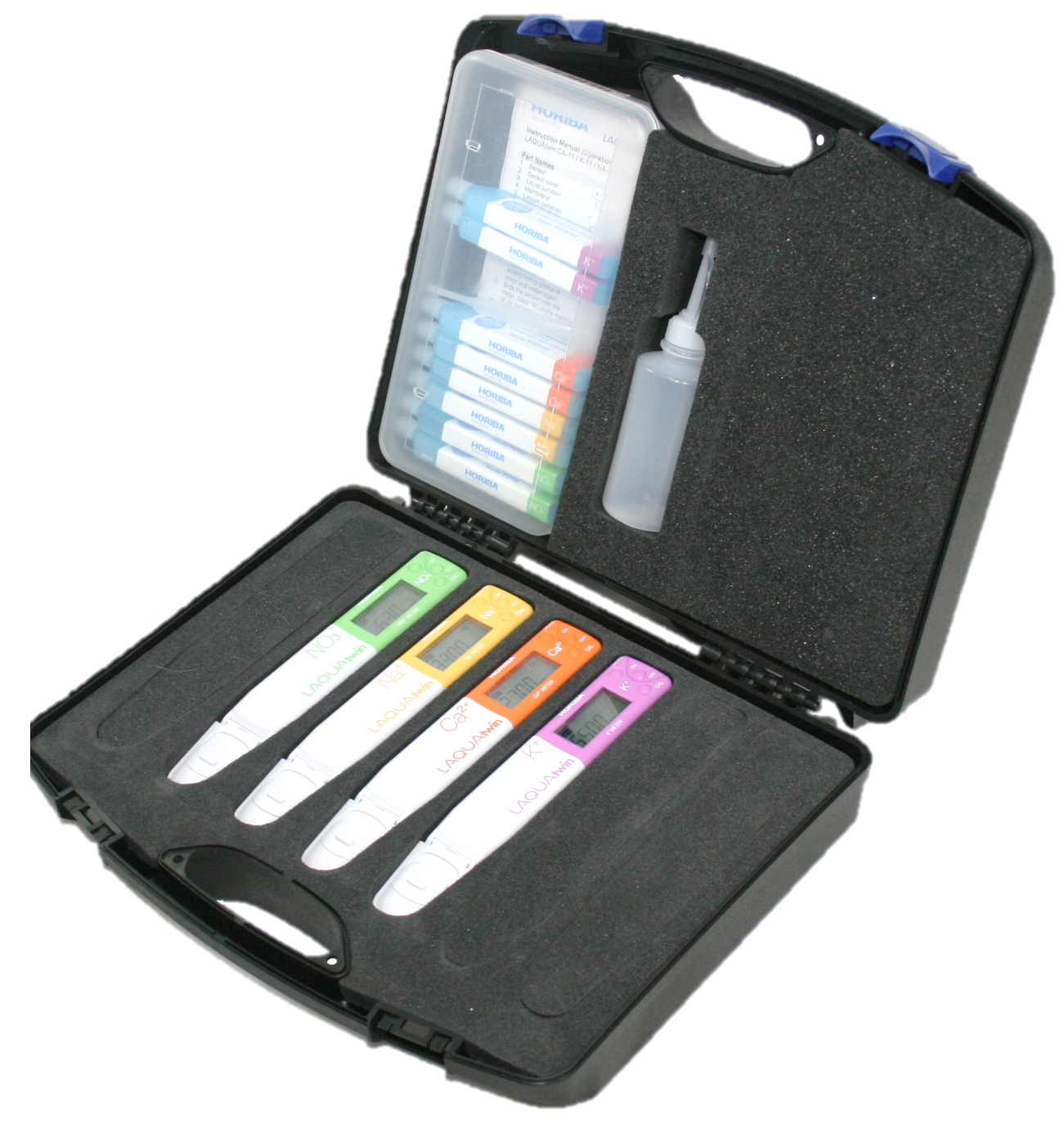
Mobile Analysis Laboratory for Ion Measurements – Versatile Use Compact kit for simultaneous determination of multiple water and environmental parameters The Horiba 4M LAQUAtwin Kit is a mobile laboratory that allows you to determine important ion parameters directly on-site. The case contains pocket testers for measuring sodium, potassium, nitrate, and calcium, as well as for temperature measurement. Each device uses ion-selective electrodes for targeted analysis of small samples and provides fast, reliable results. In addition to the four measurement devices, the kit includes calibration solutions and a wash/spray bottle for sensor cleaning. The sensors can be stored dry without special storage solutions. Compact Multi-Parameter Kit for Flexible On-Site Analyses The set is designed for measurement tasks where multiple ions need to be detected simultaneously, for example when monitoring drinking and process water, performing environmental checks of water bodies, conducting aquaculture analyses, or agricultural research. Thanks to the case, all essential testers including accessories are always on hand and ready for immediate use. The measurement results are available in a short time and are reliable and reproducible – ideal for routine and control measurements in the field. All components are neatly arranged in the case and ready for use at any time. An additional advantage is that the sensors can be stored dry without special storage solutions. Due to its compact design, the kit is particularly suitable for mobile applications where multiple ion parameters need to be determined quickly one after the other or in parallel. Why Multi-Parameter Ion Measurements Are Useful – and a Mobile Kit Is Ideal In many applications, not just a single measurement is important, but the interaction of multiple ion parameters. Sodium, potassium, nitrate, and calcium together influence water quality, biological processes, plant growth, and technical operations. Single measurements in a laboratory are often time-consuming and inflexible. A mobile analysis kit allows simultaneous detection of multiple parameters directly on-site. This allows relationships to be recognized more quickly, decisions to be made more reliably, and measurement campaigns to be carried out more efficiently. The Horiba 4M LAQUAtwin Kit combines these advantages in a compact, user-friendly system. Frequently asked questions How long is the warranty period for HORIBA pocket testers? The warranty period is two years from delivery for commercial customers. How many measurements can be taken before the sensor needs to be replaced? This varies depending on the application, use and storage of the Horiba tester. As a rule, the sensor should be replaced after one year. How long is the warranty period for replacement sensors for pocket testers? The warranty period is 12 months after delivery for commercial customers. How do you clean the pocket tester? The pocket tester can be rinsed under water. We recommend cleaning with DI water (deionised). Tissue paper is recommended for drying after cleaning. How can the pocket tester be reset to factory settings? (e.g. in the event of an incorrect measurement result) This information can be found in the operating instructions. These can be found in the download area of the shop and on the product. Is calibration necessary before each measurement? Basically, yes. Further information can be found in the operating instructions.
Price display net
(excl. VAT)Price display gross
(incl. VAT)You can change this selection at any time.