
Importance of Nutrient Measurement in Potato Plants
Nutrient measurement is essential for the growth, yield, and quality of potato crops. Potatoes require a balanced supply of nitrate (NO₃⁻), potassium (K), calcium (Ca), and appropriate soil pH to ensure optimal development. Monitoring these nutrients in soil and plant tissues helps optimize fertilization, prevent deficiencies, and enhance crop productivity


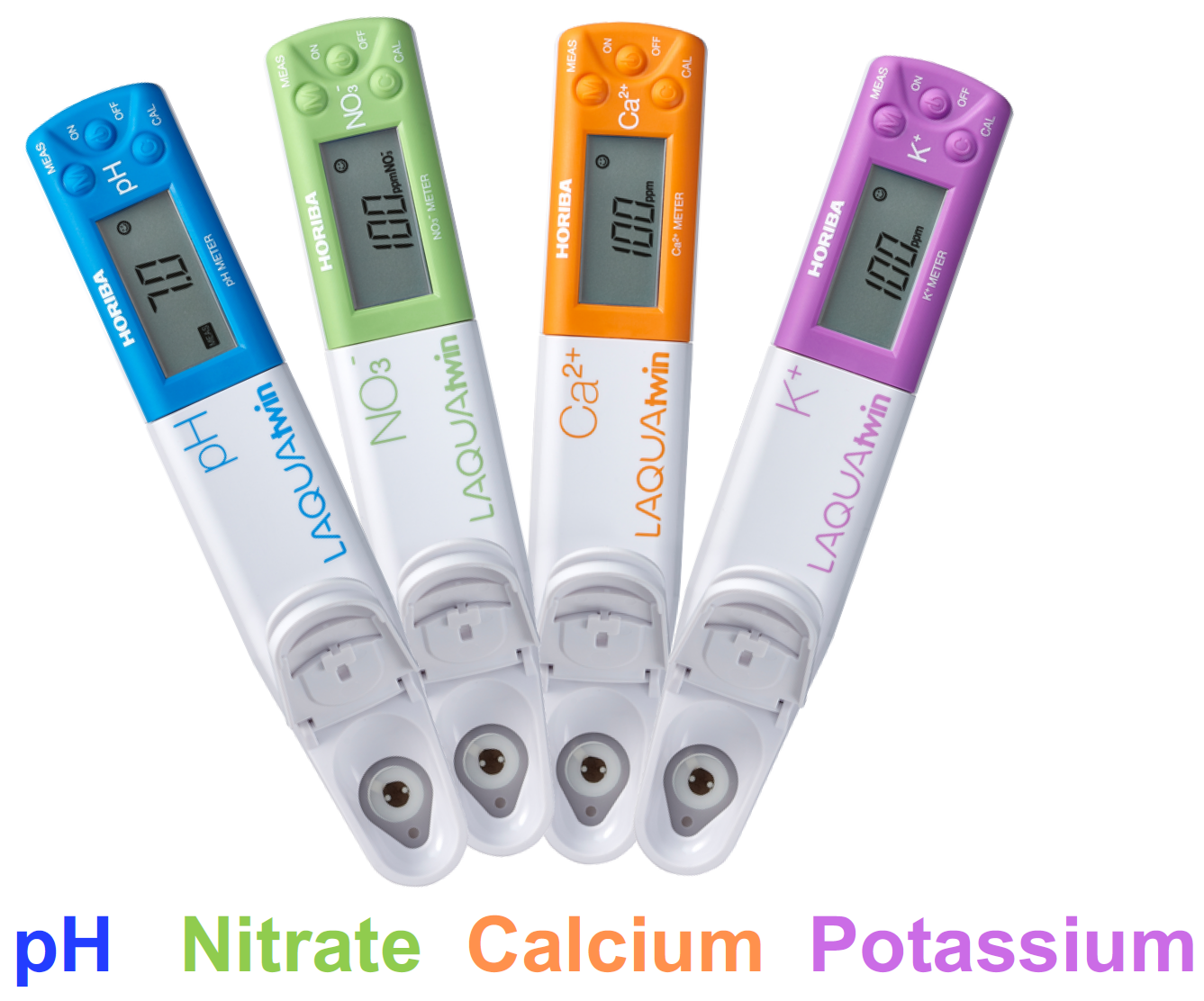
Importance of Nutrient Measurement in Potato Plants
- Optimized Nitrogen Utilization (Nitrate Measurement): Ensures sufficient nitrogen for vegetative growth and tuber development. Avoids excessive nitrogen application, which can lead to delayed tuber formation.
- Potassium's Role in Tuber Formation: Supports starch synthesis, improving tuber size and quality. Enhances disease resistance and stress tolerance.
- Calcium for Cell Wall Strength: Prevents tuber disorders such as internal browning and hollow heart. Strengthens plant structure and improves shelf life.
- pH Regulation for Nutrient Availability: Ensures efficient nutrient uptake by maintaining an optimal pH (5.5–6.5). Prevents nutrient lock-up caused by highly acidic or alkaline soils.
- Sustainable Fertilizer Use: Reduces over-application of nutrients, minimizing environmental impact. Improves nutrient-use efficiency, leading to cost-effective crop management.
Deficiencies and their Effects in Potato Plants
- Nitrate (Nitrogen) Deficiency: Symptoms: Yellowing of lower leaves, stunted growth, reduced tuber yield. Causes: Poor soil nitrogen levels, excessive leaching, improper fertilization.
- Potassium Deficiency: Symptoms: Leaf margins turn brown or scorched, weak stems, reduced starch content in tubers. Causes: Sandy soils with low K retention, heavy rainfall, and unbalanced fertilization.
- Calcium Deficiency: Symptoms: Internal browning, poor tuber skin quality, susceptibility to disease. Causes: Low soil calcium levels, poor translocation in plants, high soil magnesium interfering with calcium uptake.
- pH Imbalance: Acidic Soil (pH <5.5): Limits nutrient availability, particularly calcium and potassium. Alkaline Soil (pH >7.0): Reduces nitrogen efficiency and micronutrient uptake.
Methods of Nutrient Measurement
Differences in crop yield between fields can be attributed to various factors, with nutrient management being a key determinant. Soil pH and calcium measurement are critical, as they influence the availability of essential nutrients. Measuring nitrate and potassium levels in fresh plant sap provides real-time insight into the nutrients absorbed by the plant, reflecting its immediate nutritional status. Field testing enables growers to detect nutrient imbalances before visible deficiency symptoms appear, allowing proactive fertilization strategy adjustments.
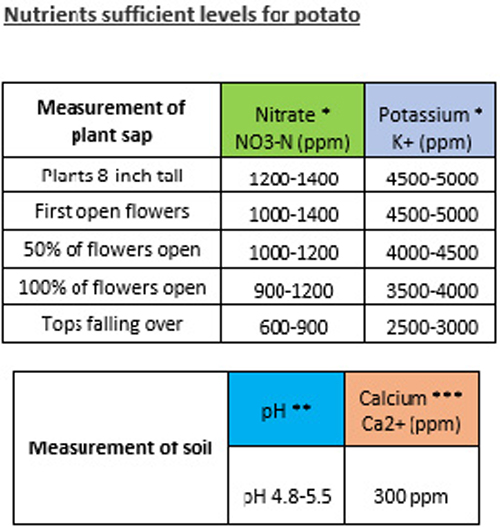
Benefits of Measuring Nutrients in Soil and Plant Sap
- Immediate response: Field testing provides instant results compared to laboratory analysis.
- Simple and quick measurement: Tests can be performed directly in the field without specialized equipment.
- Improved fertilization planning: Soil and sap measurements indicate how crops are responding to current fertilization strategies, enabling timely adjustments.
Method
1. Soil:
- Add 20 mL of deionized water to 20 gram of soil in a glass container (Dilution 1:1).
- Stir for 5 minutes (ideally let the mixture rest for an hour).
- After calibrating the LAQUAtwin meters, take the water phase of the soil sample with a pipette and place a few drops on the sensor.
2. SAP:
- Select the youngest fully developed leaves, sampling 10–20 leaves per hectare.
- Collect leaves in the morning and always at the same time of day (ideal conditions: 18–25°C, 60–85% relative humidity).
- Separate the leaf from the petiole, cut the petiole into small pieces, and squeeze sap with a garlic press.
- After calibrating the LAQUAtwin meters, place the sap on the sensor and take the reading.
Best Practices for Nutrient Management in Potatoes
- Apply nitrogen in split doses to support initial growth without delaying tuberization.
- Ensure adequate potassium levels throughout the growing season to enhance yield and quality.
- Incorporate calcium-rich fertilizers to prevent internal tuber disorders.
- Monitor and adjust soil pH using lime (for acidic soils) or sulfur (for alkaline soils).
- Conduct regular soil and tissue tests to make informed fertilization decisions.
Monitoring nitrate, potassium, calcium, and soil pH in potato plants is essential for optimizing growth, improving tuber quality, and preventing nutrient-related disorders. Regular nutrient assessments enable precise fertilization, leading to sustainable potato production and enhanced farm profitability. Implementing best nutrient management practices ensures healthier crops and higher yields.
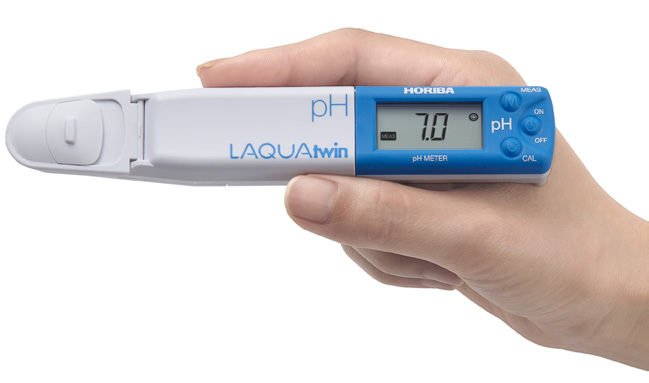
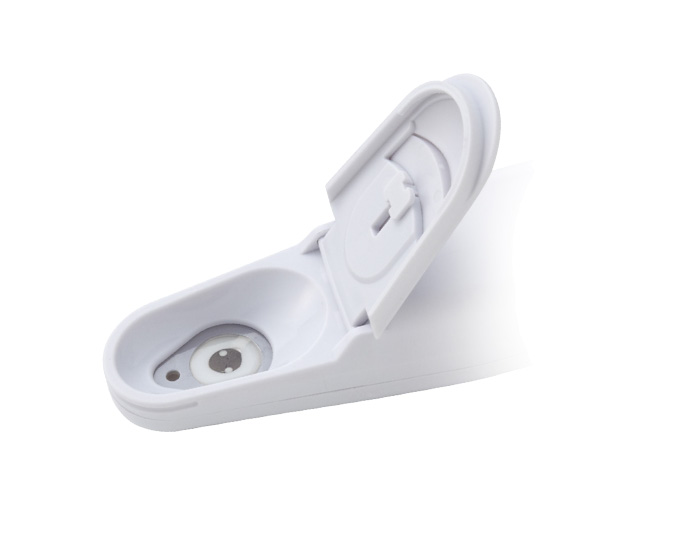
LAQUAtwin: the only meters with flat sensor technology.
HORIBA’s highly-sensitive, flat sensor technology opens up new possibilities for sampling and sample types. Only a small amount of sample is required, so you can easily sample in situ without the need for beakers or other labware. Sensors are easily replaced as required.
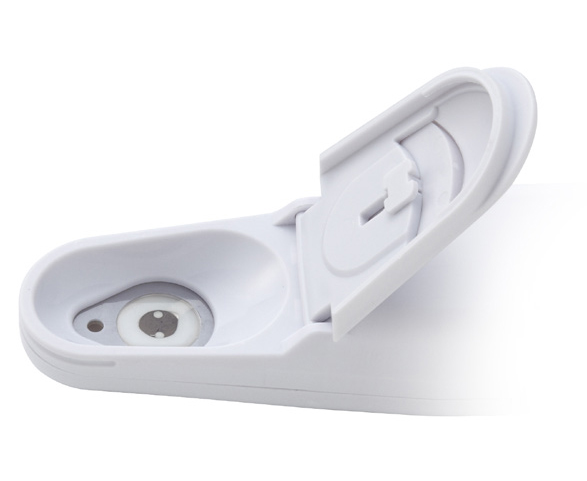
Calibrate and measure at the touch of a button — the smiley face will tell you when the result can be read.
LAQUAtwin is fully waterproof and dustproof.
The meter and sensor are fully waterproof* and dustproof, so you can take it anywhere.
* IP67 rated. Will withstand immersion for 30 minutes at 1 m. Not suitable for underwater use.
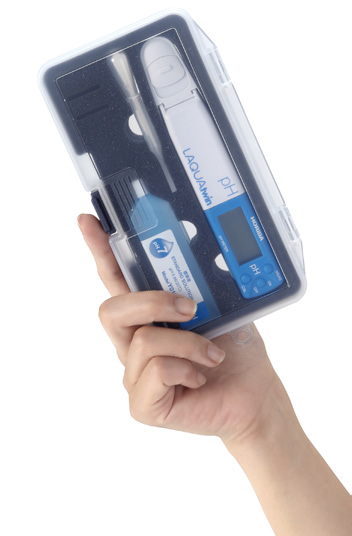
Carry case comes as standard for handy portability.
The compact carry case contains everything you need for your measurements, including the standard solution and sampling sheets.
Matching products

Horiba LAQUAtwin Nitrate Ion Tester NO3-11 for Precise On-Site Measurements Handheld tester with 2-point calibration, ideal for water and environmental measurements The Horiba LAQUAtwin Nitrate Ion Tester (NO3-11) is a portable device for direct determination of nitrate ions (NO3) and temperature in liquids and samples. Thanks to the ion-selective electrode and compact design, the tester delivers fast and reliable results. The integrated temperature unit enables temperature-compensated analysis and clearly displays both nitrate and temperature values on the digital LCD display. Mobile Nitrate Ion Tester for Precise On-Site Analyses The integrated temperature measurement enables temperature-compensated analysis and shows both nitrate and temperature values. Only very small sample volumes are required, minimizing sample consumption and increasing efficiency in daily use. The tester can be set up with up to two calibration points, with features such as automatic standard recognition, adjustable calibration values, and multiplication compensation for flexibility. Only minimal sample volumes are needed for each analysis, reducing sample usage and improving efficiency. Why Nitrate Measurement Is Crucial – and a Pocket Tester from Horiba Is Ideal Nitrate measurement plays a central role in agriculture, water management, and environmental monitoring. Elevated nitrate concentrations can affect drinking water quality, stress ecosystems, and contribute to over-fertilization. At the same time, nitrate is an essential nutrient for plants, and targeted control is vital for sustainable agriculture. A mobile nitrate pocket tester enables rapid on-site analysis without time-consuming laboratory tests. This allows early detection of contamination, immediate action, and reliable monitoring of legal limits. The Horiba LAQUAtwin NO3-11 combines this flexibility with high measurement accuracy and easy operation – ideal for routine checks and scientific applications. The tester can be configured with up to two calibration points. Features like automatic standard recognition, adjustable calibration values, and multiplication compensation provide high adaptability to different sample types and measurement conditions. Typical Applications of the Horiba LAQUAtwin Nitrate Ion Tester (NO3-11) Agriculture: To optimize fertilizer use, promote plant growth, and minimize environmental impact, farmers and agronomists use the tester to monitor nitrate levels in soils and irrigation water. Water Quality Management: To maintain nitrate concentrations within safe limits, the NO3-11 is used in water management to check drinking and wastewater quality. Environmental Monitoring: The NO3-11 allows environmental technicians and scientists to quickly analyze nitrate contamination in rivers, lakes, and groundwater, ensuring compliance with environmental standards and identifying pollution sources. Research and Development: The tester is used by scientists in environmental science, hydrology, and soil science to conduct detailed studies of the nitrogen cycle and the effects of nitrates on ecosystems. Frequently asked questions How long is the warranty period for HORIBA pocket testers? The warranty period is two years from delivery for commercial customers. How many measurements can be taken before the sensor needs to be replaced? This varies depending on the application, use and storage of the Horiba tester. As a rule, the sensor should be replaced after one year. How long is the warranty period for replacement sensors for pocket testers? The warranty period is 12 months after delivery for commercial customers. How do you clean the pocket tester? The pocket tester can be rinsed under water. We recommend cleaning with DI water (deionised). Tissue paper is recommended for drying after cleaning. How can the pocket tester be reset to factory settings? (e.g. in the event of an incorrect measurement result) This information can be found in the operating instructions. These can be found in the download area of the shop and on the product. Is calibration necessary before each measurement? Basically, yes. Further information can be found in the operating instructions.

Precise Potassium Ion Measurement on the Go – Mobile, Reliable, and Easy Precise potassium ion measurement with 2-point calibration and integrated temperature display The Horiba K-11 Potassium Pocket Tester was designed to determine potassium in a wide variety of samples with high precision. Thanks to the ion-selective electrode and the digital LCD screen with backlight, the tester is perfect for mobile water quality and environmental analyses. The minimal sample volume of only 0.3 ml (0.05 ml with sampling sheet) ensures reliable results even with small sample sizes. With its 2-point calibration and automatic standard recognition, the device can be flexibly adapted to different measurement conditions. The IP67 rating for dust and water protection, along with a long battery life of up to approximately 400 hours, makes the tester highly reliable for mobile use. Technical Features for Reproducible Potassium Measurements The potassium tester covers a wide measurement range from 4 to 9,900 ppm (mg/L) and additionally displays temperatures up to 50 °C with a resolution of 0.1 °C. The integrated temperature compensation ensures stable results even under changing environmental conditions. Automatic standard recognition, adjustable calibration values, and multiplication compensation guarantee high reproducibility across different sample types. This makes the K-11 suitable for both routine and demanding analytical tasks. Why Potassium Measurement Is Important – Ideal with the Horiba K-11 Hand Tester Potassium is an essential parameter in water, environmental, agricultural, and food analysis. In water bodies, potassium content affects water quality, in soils it is a key nutrient for healthy plant growth, and in food it plays an important role for nutrition and labeling requirements. A mobile potassium hand tester enables rapid on-site analysis without time-consuming laboratory testing. Changes can be detected immediately, and decisions can be made right away. The Horiba K-11 combines this flexibility with high measurement accuracy and ease of use – ideal for fieldwork, routine checks, and scientific studies. Where Can It Be Used? Environmental Monitoring: The K-11 is a fast and precise measurement tool for environmental technicians and scientists monitoring potassium concentrations in water bodies to ensure water quality and identify contamination sources. Agriculture: The K-11 allows farmers and agronomists to measure potassium in soil. This is crucial for fertilizer application and improving plant growth. Easy evaluation of soil extracts enables precise nutrient requirement determination. Food Industry: The tester is used by quality assurance personnel to check potassium content in beverages and food. These measurements are important for product development, health assessments, and compliance with nutritional labeling requirements. Teaching, Research, and Development: By deepening the understanding of potassium’s role in biological and chemical processes, the K-11 serves researchers and educators as a useful tool for experimental studies and educational purposes. Frequently asked questions How long is the warranty period for HORIBA pocket testers? The warranty period is two years from delivery for commercial customers. How many measurements can be taken before the sensor needs to be replaced? This varies depending on the application, use and storage of the Horiba tester. As a rule, the sensor should be replaced after one year. How long is the warranty period for replacement sensors for pocket testers? The warranty period is 12 months after delivery for commercial customers. How do you clean the pocket tester? The pocket tester can be rinsed under water. We recommend cleaning with DI water (deionised). Tissue paper is recommended for drying after cleaning. How can the pocket tester be reset to factory settings? (e.g. in the event of an incorrect measurement result) This information can be found in the operating instructions. These can be found in the download area of the shop and on the product. Is calibration necessary before each measurement? Basically, yes. Further information can be found in the operating instructions.

HORIBA pH Handheld Tester – Ideal for Water and Environmental Analysis Precise pH measurements on-site – compact, reliable, and easy to use The Horiba LAQUAtwin pH tester is ideal for water quality testing in rivers, drinking water, and process water. With a measurement range of 0.0 to 14.0 pH and a 2-point calibration, the tester is suitable for a wide range of pH analyses. Just a single drop of sample provides quick and reliable measurement results. The tester combines electrode, display, and sample container in a robust IP67-rated housing that is dust- and waterproof. The digital display with backlight shows both pH and mV values. Features such as automatic stability detection and Auto-Hold simplify operation. With up to 400 hours of battery life, the tester is suitable for extended measurement series. Included are calibration buffer solutions (pH 4.01 & 7.00), batteries, pipette, instruction manual, and a carrying case. Handheld pH tester for fast and precise results With its wide measurement range and 2-point calibration, the Horiba LAQUAtwin pH tester is suitable for a variety of pH analyses. Even a single drop of sample is enough to obtain fast and accurate results. Its compact design makes the mobile pH tester highly user-friendly and allows on-site measurements without complex sample preparation or laboratory infrastructure. Robust, waterproof design with comprehensive features The tester integrates the electrode, display, and sample container in a robust IP67-rated housing that is dust- and waterproof. The digital backlit display clearly shows pH and mV values. Features like automatic stability detection and Auto-Hold simplify daily use. With a battery life of up to 400 hours, the tester is suitable for long measurement series. The package includes calibration buffer solutions (pH 4.01 & 7.00), batteries, pipette, instruction manual, and a practical carrying case. Typical applications of the Horiba LAQUAtwin pH Pocket Tester Aquaculture and corals Aquariums Beer, beverages, and food Heating systems Laboratories and schools Horticulture Water treatment Frequently asked questions How long is the warranty period for HORIBA pocket testers? The warranty period is two years from delivery for commercial customers. How many measurements can be taken before the sensor needs to be replaced? This varies depending on the application, use and storage of the Horiba tester. As a rule, the sensor should be replaced after one year. How long is the warranty period for replacement sensors for pocket testers? The warranty period is 12 months after delivery for commercial customers. How do you clean the pocket tester? The pocket tester can be rinsed under water. We recommend cleaning with DI water (deionised). Tissue paper is recommended for drying after cleaning. How can the pocket tester be reset to factory settings? (e.g. in the event of an incorrect measurement result) This information can be found in the operating instructions. These can be found in the download area of the shop and on the product. Is calibration necessary before each measurement? Basically, yes. Further information can be found in the operating instructions.

Mobile Calcium Ion Tester from Horiba with Temperature Measurement – precise, compact, robust Handheld Ca²⁺ pocket tester with 2-point calibration and temperature display – ideal for water and environmental applications The mobile Horiba LAQUAtwin calcium ion tester measures both the Ca²⁺ concentration and the temperature of a sample. Equipped with an ion-selective sensor, a digital LCD display, and a minimal sample volume of only 0.3 ml (0.05 ml when using the sampling sheet), it delivers fast and reliable measurement results. Thanks to the integrated temperature display and automatic temperature compensation, calcium values can be measured accurately even under changing environmental conditions – making the device ideal for mobile applications. Mobile calcium ion tester for precise on-site measurements With two calibration points and automatic standard recognition (150 and 2000 ppm), the device can be flexibly adapted to different measurement situations. Temperature-compensated measurement, multiplicative compensation, automatic stability and hold modes, as well as automatic shut-off ensure easy and reliable operation. The tester is dustproof and waterproof according to IP67 and offers a long battery life of approximately 400 hours. It is supplied complete with standard solutions, sampling sheets, pipette, and batteries. Why calcium measurement is important – optimal results with the Horiba handheld tester Calcium is a key parameter in water, environmental, aquaculture, and food analysis. Calcium concentration influences water hardness, biological processes, coral growth, and product quality in beverages and food. Deviations can lead to ecological, technical, or quality-related impacts. A mobile calcium handheld tester allows fast analysis directly at the point of use without complex laboratory procedures. This makes it possible to detect changes immediately and take timely action. The Horiba LAQUAtwin calcium tester combines this flexibility with high measurement accuracy, simple operation, and a robust design. Typical applications of the Horiba LAQUAtwin calcium tester Aquaculture and corals Laboratories and schools Water treatment Beverages and food Frequently asked questions How long is the warranty period for HORIBA pocket testers? The warranty period is two years from delivery for commercial customers. How many measurements can be taken before the sensor needs to be replaced? This varies depending on the application, use and storage of the Horiba tester. As a rule, the sensor should be replaced after one year. How long is the warranty period for replacement sensors for pocket testers? The warranty period is 12 months after delivery for commercial customers. How do you clean the pocket tester? The pocket tester can be rinsed under water. We recommend cleaning with DI water (deionised). Tissue paper is recommended for drying after cleaning. How can the pocket tester be reset to factory settings? (e.g. in the event of an incorrect measurement result) This information can be found in the operating instructions. These can be found in the download area of the shop and on the product. Is calibration necessary before each measurement? Basically, yes. Further information can be found in the operating instructions.